
Quantum computing is the most hyped — and least understood — technology in the news cycle. Headlines promise it will break all encryption, cure diseases, and solve climate change, usually in the same paragraph. The reality is more nuanced, more interesting, and worth understanding. Here is quantum computing explained without the jargon, the mysticism, or the marketing.
The One-Minute Version
Your laptop stores information in bits: switches that are either 0 or 1. A quantum computer stores information in qubits, which exploit quantum physics to represent 0 and 1 in more flexible ways — including combinations of both at once. For certain carefully chosen problems, this lets a quantum computer explore many possible answers in parallel, in ways no ordinary computer can match. It will not replace your laptop; it is a specialized tool for problems that are currently intractable.
Bits vs. Qubits: The Core Idea
Think of a bit as a coin lying flat: heads or tails. A qubit is like a coin spinning on a table — while it spins, it is in a sense both heads and tails, with probabilities attached. This property is called superposition.
Now imagine two spinning coins that are linked so that when one lands heads, the other always lands tails, no matter how far apart they are. That link is entanglement, and it is the real magic ingredient: entangled qubits act as a coordinated system, so adding qubits multiplies the system’s complexity exponentially rather than linearly.
The catch — and there is always a catch — is that the moment you “look” at the qubits (measure them), the spinning stops and you get an ordinary answer: a string of 0s and 1s. Quantum algorithms are clever procedures that arrange the quantum spinning so that, when measured, the correct answer is the most likely outcome. Designing such algorithms is extraordinarily hard, which is why quantum computers are only faster for specific problems, not everything.
It also helps to understand what a qubit is physically. Different companies build qubits from different things: superconducting circuits chilled near absolute zero, individual ions trapped by lasers, photons traveling through optical chips, or neutral atoms held by optical tweezers. Each approach has trade-offs in stability, scalability, and error rates — and nobody yet knows which will win. That diversity of approaches is itself a sign of a young field.
Why “Quantum Supremacy” Headlines Mislead
You may have seen announcements that a quantum computer solved in minutes what would take a supercomputer millennia. Those demonstrations are real but narrow: they involve contrived benchmark problems designed to show off quantum hardware, not useful work. It is like a concept car setting a speed record on a salt flat — impressive engineering, but not the vehicle you will drive to work.
The honest milestone to watch is quantum advantage for practical problems: a quantum computer solving a real chemistry, logistics, or materials problem faster, cheaper, or better than the best classical alternative. We are getting closer, but we are not there yet for most applications.
Part of the confusion comes from moving goalposts on both sides. Classical computing keeps improving too — better algorithms and GPUs have repeatedly “caught up” to claimed quantum speedups on benchmark problems. This back-and-forth is healthy science, but it makes for confusing headlines. The signal to watch is not any single demonstration but the trend: error rates falling, qubit counts rising, and real applications inching closer.
What Quantum Computers Might Actually Be Good For
Drug discovery and materials science
Molecules are quantum systems, and simulating them on classical computers is brutally expensive — the math grows exponentially with molecular size. Quantum computers speak the same language as molecules, so they could one day simulate new drugs, catalysts, and battery materials with far less trial and error. This is widely considered the most promising near-term application.
Consider what this could mean concretely: designing a better catalyst for fertilizer production could cut enormous amounts of energy use; simulating battery chemistry could accelerate the EVs and grid storage the world needs; modeling proteins could shorten drug discovery timelines. None of this is guaranteed, but the fit between the tool and the problem is unusually natural.
Optimization problems
Airline scheduling, supply chains, financial portfolios, traffic flow — problems with astronomical numbers of possible combinations. Quantum approaches may find better solutions faster than classical heuristics, though this is still an active research area with healthy skepticism. Classical optimization is also excellent and improving, so quantum must clear a high bar to matter here.
Cryptography — both breaking and making
The famous threat: a sufficiently powerful quantum computer could run Shor’s algorithm and break the public-key encryption (RSA, elliptic curve) that secures the internet. The timeline is debated, but the response is already underway — post-quantum cryptography, new encryption standards designed to resist quantum attacks, is being standardized and deployed now. The practical advice: this is a “harvest now, decrypt later” concern for governments and long-lived secrets, not a reason to panic about your email today.
There is also a constructive side: quantum physics enables new security tools, like quantum key distribution, which uses the laws of physics to detect eavesdropping. These are niche and expensive today, but they illustrate that quantum cuts both ways for security.
What they will NOT do
Quantum computers will not make your games faster, browse the web better, or run AI chatbots (those are classical workloads, and excellent at them). Anyone selling you “quantum” as a general speed boost is selling mystique, not physics. The set of problems with proven quantum speedups remains small and specialized — which is fine, because those problems matter enormously.
Why Building Them Is So Hard
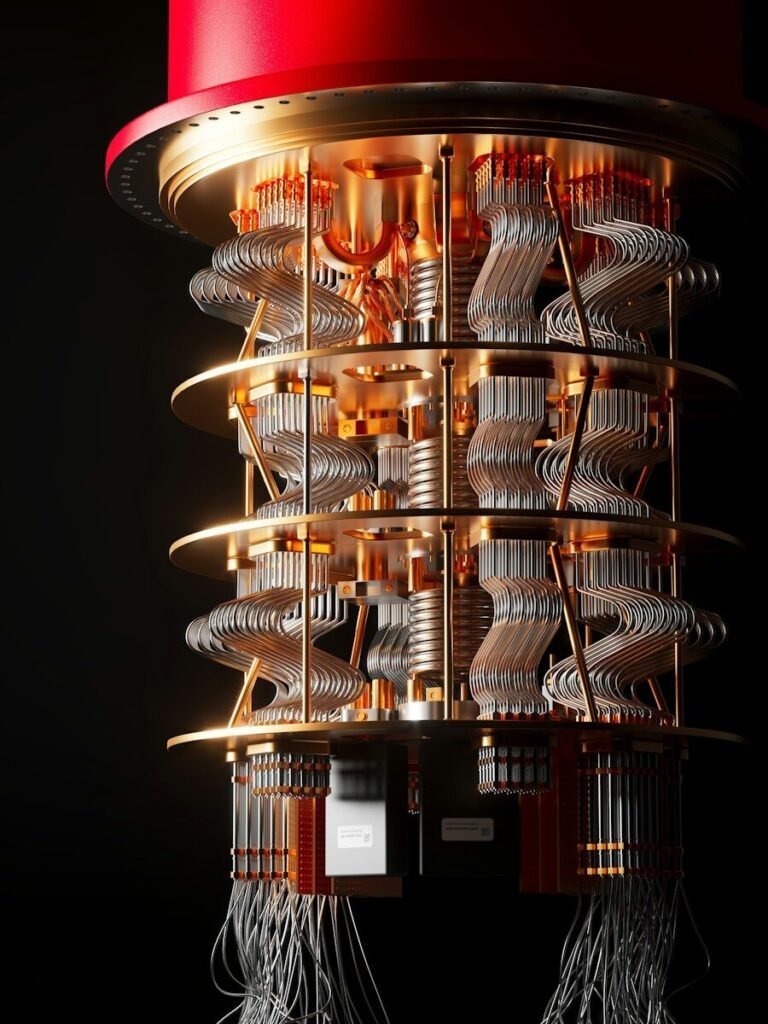
Qubits are exquisitely fragile. Stray heat, vibration, or electromagnetic noise destroys their quantum state — a problem called decoherence. That is why quantum computers live in dilution refrigerators colder than deep space and look like chandeliers of gold wiring.
The industry’s central challenge is error correction: using many imperfect physical qubits to create one reliable “logical” qubit. Progress here has been genuinely impressive — error rates are falling and logical qubits are improving — but building a machine with enough reliable qubits for the headline applications remains an enormous engineering climb. Think years of steady progress, not a sudden breakthrough.
To put the scale in perspective: breaking widely used encryption might require millions of physical qubits working together, while today’s machines have hundreds to thousands, with high error rates. Closing that gap requires progress on every front simultaneously — better qubits, better error correction, better control electronics, better software. Each front is advancing, but the multiplication of challenges is what makes timelines so uncertain.
Where Things Stand Now
We are in the NISQ era — Noisy Intermediate-Scale Quantum: machines with tens to hundreds of qubits that are too error-prone for the grand applications but increasingly useful for research, benchmarking, and hybrid algorithms that split work between quantum and classical processors. Tech giants, startups, and governments are all investing heavily, pursuing different qubit technologies because nobody knows which will win.
The field is also getting more honest: researchers increasingly publish null results and realistic timelines, and the conversation has shifted from “when will it change everything” to “which problems will it change first.” That maturation is a healthy sign. Funding continues to flow, but it increasingly rewards demonstrated progress over bold claims — which is how you want a deep-tech field to work.
What It Means for You
For most readers, quantum computing’s near-term impact is indirect: better medicines designed with quantum-assisted simulation, more efficient logistics and energy systems, and the quiet migration of internet security to quantum-resistant encryption (which will happen in software updates you barely notice). You will probably never own a quantum computer — you will rent time on one through the cloud for specific tasks, the way you rent supercomputer time today.
The deeper lesson is about technological literacy: quantum computing rewards the same skepticism as any hyped technology. Ask what problem it solves, what it costs, and when — and beware anyone who answers only in superlatives. The most reliable experts in the field are the ones who tell you what quantum computers cannot do.
Frequently Asked Questions
Will quantum computers break Bitcoin and online banking?
Not imminently. Breaking modern encryption requires large, error-corrected quantum computers that do not exist yet, and the security community is actively migrating to quantum-resistant algorithms. It is a real long-term concern being managed, not an impending catastrophe.
How is a quantum computer different from a supercomputer?
A supercomputer is a very fast classical computer — same bits, just more of them and faster. A quantum computer is a fundamentally different kind of machine that processes information using quantum physics. They are complementary: supercomputers remain better at the vast majority of tasks.
When will quantum computers be useful?
Honest answer: nobody knows exactly. Narrow research uses exist now; practical advantage in chemistry and materials science may arrive within years; the grand applications (like breaking RSA) are further out. Treat any precise date with deep skepticism.
Do I need to learn quantum physics to follow this field?
No. The conceptual picture — qubits, superposition, entanglement, and the measurement catch — is enough to read the news critically. The math matters for building the machines, not for understanding what they mean.
Is “quantum” in product names meaningful?
Almost never. “Quantum” branding on consumer products — headphones, mattresses, water bottles — is pure marketing with no connection to quantum computing. Real quantum technology lives in research labs and specialized data centers.