
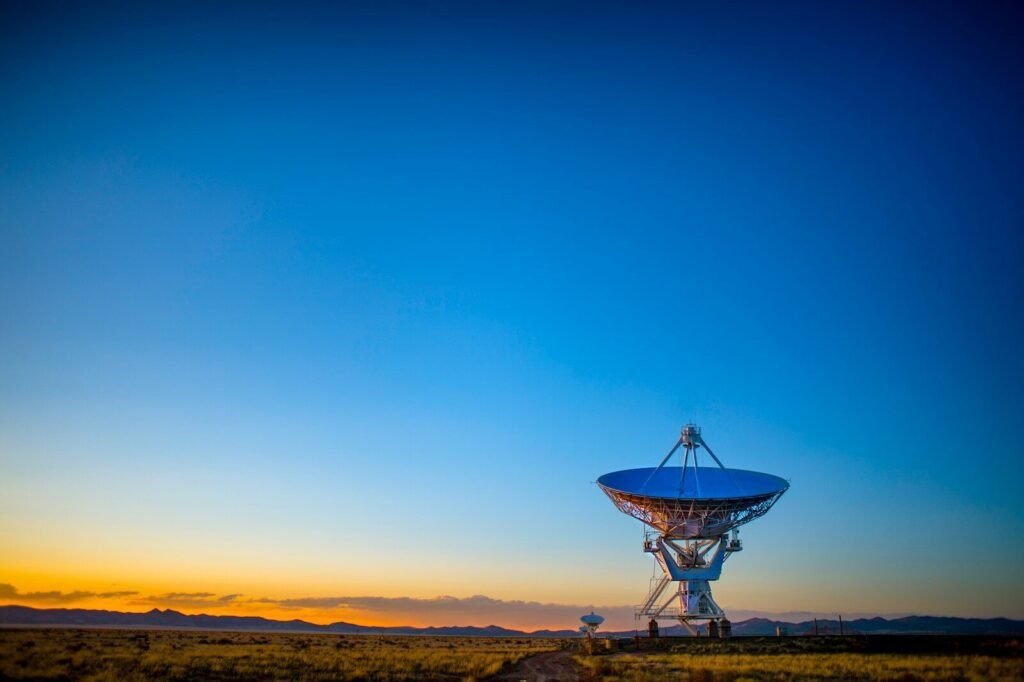
For everyone in a city with fiber to the building, the internet is a solved problem. For the hundreds of millions of people living beyond the reach of cables and cell towers, it is not. Two technologies are racing to close that gap: low-orbit satellite internet beaming down from space, and 5G networks pushing outward from towns and highways. Both promise fast internet anywhere. They work in very different ways, and which one wins your rooftop depends on where you live and what you need.
How Each Technology Works
To compare them fairly, it helps to understand what is actually happening when your data travels.
Satellite internet: broadband from orbit
Satellite internet works by bouncing your connection off spacecraft overhead. The older generation used a handful of huge satellites parked in geostationary orbit, 35,000 kilometers up. That distance meant noticeable lag, often over half a second, which made video calls painful and online gaming nearly impossible. The new generation uses constellations of thousands of small satellites in low Earth orbit, only a few hundred kilometers up. Because the signal travels a much shorter distance, latency drops dramatically, and speeds become genuinely competitive with terrestrial broadband. Your dish talks to whichever satellite is passing overhead, handing off from one to the next every few minutes, and the satellites relay your traffic to ground stations connected to the wider internet.
5G: the tower network grows up
5G is the fifth generation of cellular technology, and it is really three technologies in one. Low-band 5G travels far and penetrates buildings well, offering a modest speed boost over 4G across wide areas. Mid-band 5G hits the sweet spot of good speed and decent range, and it is the workhorse of most 5G rollouts. High-band, or millimeter wave, 5G is blazing fast but only reaches a few city blocks and struggles with walls and rain. For rural areas, low-band and mid-band matter most, since carriers can upgrade existing towers to cover large areas without building a dense new grid.
Where Each One Wins Today
The race looks very different depending on your address.
Truly remote locations: satellite has no rival
If you live miles from the nearest town, satellite internet is often the only modern option. No tower needs to be built near you, no cable needs trenching to your door. As long as your dish has a clear view of the sky, you can get connected. This makes satellite the default answer for remote farms, mountain cabins, island communities, boats, and vehicles. Newer services even work on the move, bringing usable internet to RVs and remote worksites that never had anything better than a weak cell signal.
Small towns and suburbs: 5G is catching up fast
In small towns and the rural fringe around cities, 5G fixed wireless is expanding quickly. Carriers mount receivers on homes that convert the cellular signal into home Wi-Fi, competing directly with cable and DSL. Where mid-band 5G reaches, it often delivers speeds that handle streaming, remote work, and video calls with ease, usually with simpler installation than a satellite dish and no obstruction worries. If a carrier offers 5G home internet at your address, it is worth comparing seriously.
The in-between: it depends on your sky and your towers
Many rural households sit in the overlap zone, where both options technically work. Here the decision comes down to specifics: satellite needs a clear view of the sky and can struggle with heavy tree cover, while 5G needs a tower within reasonable range and can slow down during peak evening hours when the local tower is congested. Checking real-world coverage maps and asking neighbors what actually works is more useful than any marketing claim.
Head-to-Head: The Factors That Matter
Speed and latency
Modern low-orbit satellite services deliver download speeds that comfortably handle 4K streaming, video calls, and remote work for a typical household, with latency low enough that video conferencing feels natural. 5G fixed wireless in good coverage can match or beat those speeds, especially on mid-band, with even lower latency since the signal only travels to a nearby tower. Both are huge upgrades over old geostationary satellite or slow DSL. Neither is as consistently fast as urban fiber, which remains the gold standard.
Reliability and weather
Satellite connections can degrade in heavy rain or snow, a phenomenon known as rain fade, and they require that clear line of sight to the sky. Obstructions like dense trees can interrupt service as satellites pass. 5G is also a wireless technology and can be affected by severe weather and congestion, but a well-placed tower connection tends to be steadier day to day. Both technologies have improved enormously, but neither matches the rock-solid consistency of a buried fiber line.
Data caps and pricing
Pricing structures differ significantly. Satellite services typically charge a flat monthly rate with generous or unlimited data allowances, plus the cost of the dish hardware, which you usually buy outright or finance. 5G home internet is often priced simply with no equipment purchase, sometimes bundled with mobile plans, and frequently with no data caps. Promotional pricing is common in competitive markets. Because prices and plans change often, compare the total first-year cost, including hardware, for your specific address rather than relying on advertised starting prices.
Installation and portability
Satellite installation has become remarkably simple: modern dishes are self-aligning, so you mount it with a clear sky view, plug it in, and the dish finds the satellites itself. 5G home internet is even simpler, often just placing a gateway device near a window. Satellite has a unique advantage in portability, with options designed for travel and remote work sites, while 5G home gateways are generally tied to your service address.
What Is Coming Next
The race is not standing still. Satellite constellations keep growing, with more satellites meaning more capacity, better coverage at the edges, and service in countries that are still waiting. Direct-to-cell satellite services are beginning to let ordinary phones connect to satellites for basic messaging and eventually more, which could erase dead zones for mobile users without any new phone hardware.
On the 5G side, carriers continue expanding mid-band coverage outward, and government broadband funding in many countries is subsidizing rural tower builds and fiber extensions. The long-term trend favors hybrid connectivity: devices that seamlessly use 5G where it exists and satellite where it does not. For the user, the technology fades into the background, and the internet simply works everywhere.
Which Should You Choose?
Choose satellite internet if
You live beyond reliable cell coverage, you need connectivity at a remote or mobile location, or local wired and wireless options are slow or unavailable. Satellite is the great equalizer for the truly underserved.
Choose 5G home internet if
A carrier offers it at your address with good signal, you want simple setup with no dish and no sky-view requirements, or you can bundle it with mobile service for savings. In covered areas it is often the simpler and cheaper path.
Consider both if
You run a business from a rural location where downtime costs money. Some households keep satellite as a backup to a 5G or DSL primary connection, with automatic failover routers switching between them. Redundancy is the ultimate reliability upgrade.
The Bigger Picture
The rural connectivity race is one of the most consequential technology stories of the decade. Internet access determines who can work remotely, whose children can do online homework, and which communities can participate in the digital economy. For the first time, there are two credible, improving answers instead of zero. Competition between satellite constellations and terrestrial carriers is driving prices down and quality up, and the winner is not one technology or the other. It is everyone who finally gets a fast connection, wherever they happen to live.
Frequently Asked Questions
Is satellite internet good enough for remote work?
Yes, modern low-orbit satellite services handle video calls, cloud apps, and large file transfers well for typical remote work. Very latency-sensitive tasks like competitive gaming or high-frequency trading are better on terrestrial connections, but ordinary office work is fine.
Does satellite internet work in bad weather?
Light rain and snow are usually fine, but very heavy storms can temporarily degrade the signal. The dish is heated to melt snow in most designs. Brief weather-related slowdowns are the main reliability caveat versus wired connections.
Can I take satellite internet traveling?
Many providers now offer portability options or dedicated mobile plans for RVs, boats, and remote worksites. Check the provider’s terms for your region, since mobile use may require a specific plan.
Is 5G home internet truly unlimited?
Many 5G home internet plans advertise no data caps, but some deprioritize heavy users during congestion. Read the fine print on network management policies, especially if your household streams heavily or works with large uploads.
Will one technology eventually replace the other?
Unlikely. They are complementary: 5G is more efficient where population density justifies towers, and satellite is unbeatable where it does not. Expect them to coexist, and increasingly to work together in hybrid devices and failover setups.